
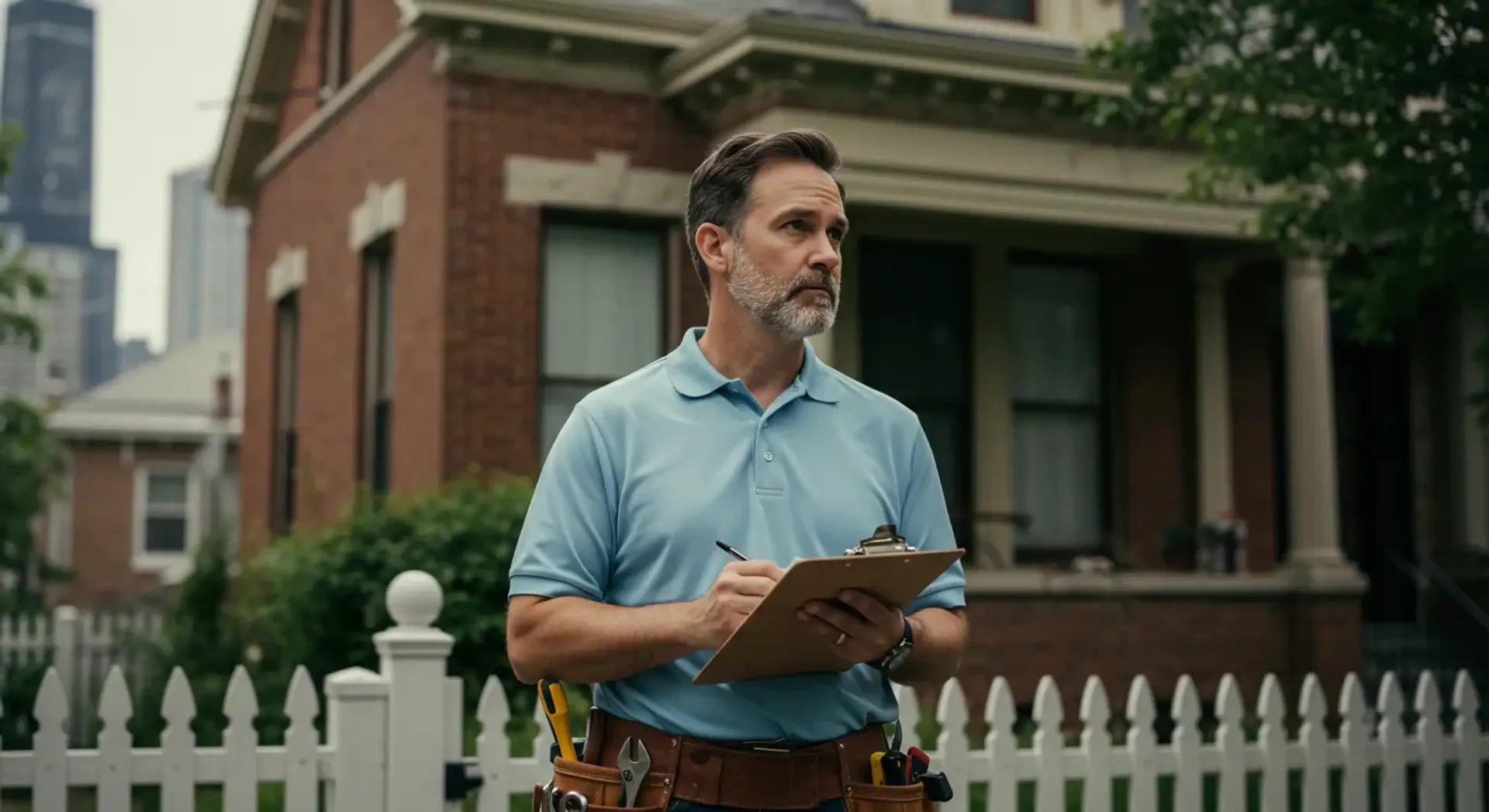
We Buy Houses in Arlington Heights, Illinois
Nearly half of Arlington Heights was built in the 1960s and ’70s. Those systems are all failing on the same schedule.
- As-Is — Any Condition
- No Fees or Commissions
- Close On Your Timeline
The local buyer for Arlington Heights homes
You can sell an Arlington Heights house as-is for cash — no repairs, no showings, no commissions — and set your own closing date. Arlington Heights is worth understanding by decade before you price anything, because the village's housing is more concentrated than its size suggests: 45% of all 33,000 homes here were built across the 1960s and 1970s, with a median build year of 1973. (Build-era and housing figures: U.S. Census Bureau, American Community Survey 2019–2023 five-year estimates, tables B25034, B25035 and B25003.)
Arlington Heights began as Dunton. William Dunton settled here in 1836 and persuaded the Illinois & Wisconsin Railroad to run track through his land, selling the company 16 acres for $350 in 1853; the first Dunton station opened in 1854 and the village took its present name in 1874. German farming families arriving from Saxony in the 1840s turned the surrounding land into truck farms sending dairy and vegetables into Chicago by rail.
The farms are what the postwar boom was built on. Arlington Heights went from under 9,000 residents in 1950 to 64,884 by 1970, and the subdivisions that absorbed that growth — Ivy Hill, Catino Estates and their neighbours — are ranches, split-levels, Cape Cods and neo-colonials on former farmland. The 1980s added larger colonials in Terramere and Northgate, and only 4.8% of the village predates 1940: the Victorian-era frame houses and early bungalows on the older streets near the Metra stations. (Population figures: U.S. Census Bureau decennial censuses; build-era shares: American Community Survey 2019–2023 five-year estimates, table B25034.)
A house built between 1960 and 1980 in Arlington Heights is now carrying a specific and predictable list. Aluminum branch wiring is common in mid-1960s and 1970s construction and routinely stops insurers. Original windows, first-generation central air, clay sewer laterals, 100-amp panels and kitchens last touched in the 1980s or '90s complete it. None of that is unusual for the age, and none of it needs fixing before you sell to us.
Arlington Heights also has something most suburbs do not: genuine rebuild demand. Mid-century ranches on deep lots inside the downtown walk-shed are routinely replaced with new construction, which means the land under a tired house can carry the offer even when the house itself needs everything.
Why Arlington Heights homeowners sell as-is
Every situation is different. Whatever you’re facing, we can help you sell without repairs, fees, or the wait of a traditional listing.
- 1960s–70s ranches, splits and Cape Cods with original windows and mechanicals
- Aluminum branch wiring in mid-1960s and ’70s construction, which insurers question
- Clay sewer laterals, 100-amp panels and first-generation central air
- Kitchens and baths last updated in the 1980s or ’90s
- Pre-1940 homes near the Metra stations with knob-and-tube and galvanized plumbing
- Homes on deep downtown-adjacent lots that a builder would rebuild rather than renovate
- Inherited homes where renovating before a listing is not realistic
The Arlington Park site, and what it does and does not change
Arlington Park shaped this village for nearly a century. The racetrack opened in 1927 on land assembled from twelve farms, burned in 1985, reopened in 1989, and closed in 2021; Churchill Downs announced the sale of the site for redevelopment in February 2021 and the Chicago Bears have owned it since 2023. Sellers reasonably ask what that means for their own number, so here is the honest answer: a redevelopment of that scale supports general reinvestment interest across Arlington Heights, but it does not put a premium on a specific house three miles away, and anyone telling you otherwise is selling you something. What genuinely moves an Arlington Heights offer is the lot — deep lots inside the downtown walk-shed draw rebuilders, and that is where land value can carry a house that needs everything.
Situations we buy Arlington Heights homes in
Behind on payments or facing a sale date? We can often close before it.
Sell an inherited or probate home as-is — no clean-out, no repairs.
Owe back taxes? They're typically paid off at closing from the proceeds.
A fast, neutral sale with a firm closing date so both parties can move on.
Sell your rental occupied or vacant — no evictions, no turnover, no repairs.
Stop paying to hold an empty house. We buy vacant homes in any condition.
Major repairs, fire or water damage, or just dated — we buy it as-is.
Moving out of the area? Close on a firm date that matches your timeline.
Don’t see your situation?
These are just the most common ones. We buy Arlington Heights houses for any reason and in any condition — including fire, water, foundation, and mold damage, houses still full of belongings, and property types beyond single-family houses.
Selling a house in Arlington Heights — FAQs
Do you buy older homes near downtown Arlington Heights?
Yes. Only about 4.8% of the village predates 1940, and those Victorian-era frame houses and early bungalows on the older streets near the Metra stations carry the full old-house profile: knob-and-tube remnants, galvanized supply lines, plaster and a foundation that has been patched. We buy them as-is. (Census, 2019–2023.)
My Arlington Heights house has aluminum wiring. Can I still sell it?
Yes. Aluminum branch wiring is common in mid-1960s and 1970s construction, which covers a large share of this village, and it is one of the most reliable ways to lose a financed buyer — insurers often decline to write over it and lenders follow. It does not affect a cash purchase. Tell us it is there and we account for it up front.
Do you buy 1960s and ’70s Arlington Heights ranches and splits?
Yes — they are the core of the village and the core of what we buy here. About 45% of Arlington Heights housing was built across those two decades, so original windows, first-generation central air, a 100-amp panel and a clay sewer lateral are ordinary for the age rather than defects. We price the work in instead of asking you to fund it first. (Census, 2019–2023.)
My house would probably be a teardown. Is it still worth selling?
Often it is worth more than owners expect. Arlington Heights has real rebuild demand, concentrated on deeper lots inside the downtown walk-shed, so the land can support a fair cash offer even when the house needs a full renovation. Whether that applies to your address depends on the lot rather than the house, and we will tell you plainly which situation you are in.
Does the Arlington Park redevelopment raise what my house is worth?
Not directly, and we would rather say so. The former racetrack site has been owned by the Chicago Bears since 2023 and a project of that size draws broad reinvestment interest to Arlington Heights, but it does not create a measurable premium on an individual home elsewhere in the village. Your number comes from the lot, the condition and recent nearby sales — not from a headline.
Would listing my Arlington Heights house net me more?
If the house has been updated and you can wait out 60 to 90 days of showings, a buyer's inspection and an appraisal, then usually yes, even after commission — Arlington Heights has strong retail demand and we will not pretend otherwise. A cash sale earns its place when there is aluminum wiring, when several systems are original, when the house is inherited and you are managing it from a distance, or when a closing date that cannot move is worth more to you than the last few percent.
How we arrive at an offer on your Arlington Heights home
You should be skeptical of anyone offering to buy a house they have not seen. Most owners get the postcards — no company name on them, a mobile number, a promise of top dollar. So here is how ours works: we use the same formula on every house, and when we present the offer we show you the math behind the number and the recent Arlington Heights sales we compared yours to. Nothing is invented on the spot, and nothing is held back.
A buyer who will not show you where their number came from is telling you something. You are welcome to check ours against what you already know about your own street — and you are never under any obligation to accept it.
And the honest part: if your Arlington Heights home has been kept up and you can wait out 60 to 90 days of showings, an inspection and a buyer's appraisal, listing it with a good local agent will usually net you more than we will — even after commission. We would rather tell you that than take an hour of your time. A cash sale earns its place when the house needs work you do not want to fund, when something about it puts lenders off, or when a closing date that will not move is worth more to you than the last few percent.
-
Buying since 2021
A local Chicagoland company, not a national brand or a call center.
-
100+ properties closed
$5,334,500 paid out for houses across the six counties we serve.
-
Our own funds, our own name
We are the buyer on the closing documents, through a local title company.
Get your free cash offer on your Arlington Heights home
Tell us about the property and your situation. We’ll reach out with a fair, as-is cash offer — no pressure, no cost, and no obligation.