
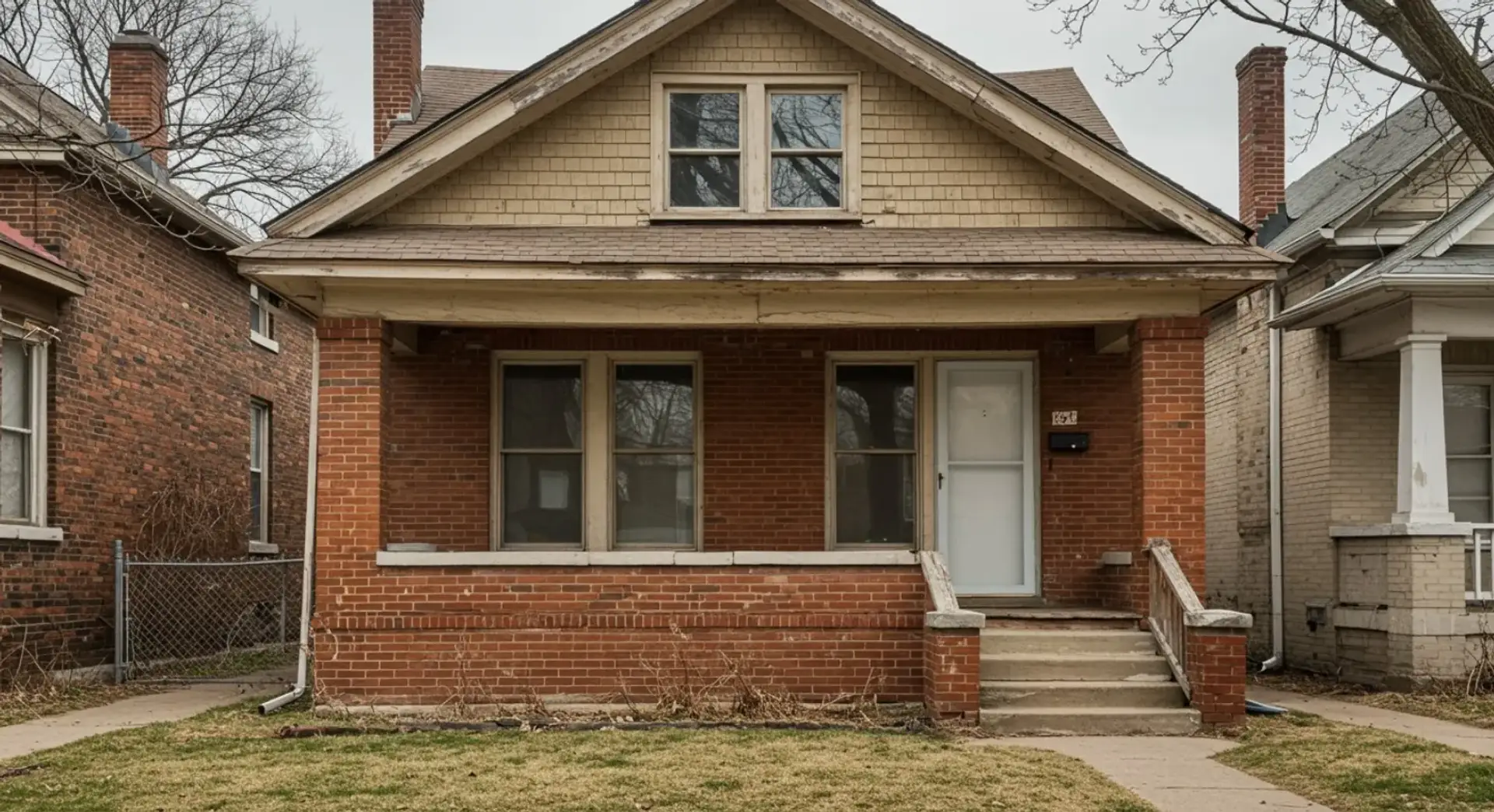
We Buy Houses in Aurora, Illinois
Downtown Victorians or a Far East Side subdivision home — we buy Aurora houses as-is for cash, in any condition.
- As-Is — Any Condition
- No Fees or Commissions
- Close On Your Timeline
The local buyer for Aurora homes
You can sell an Aurora house as-is for cash — no repairs, no commissions, no showings — and choose the closing date yourself. Which Aurora you live in usually decides why that is worth doing, because Illinois' second-largest city holds two housing markets with almost nothing in common.
The historic core, west and east of the Fox River, grew after the Chicago, Burlington & Quincy Railroad moved its headquarters and shops here in 1855. Aurora went on to become one of the first cities in the country to light its streets entirely by electricity — the system switched on in November 1881, and Aurora adopted the nickname City of Lights in 1908. The housing from those decades is still standing: Italianate frame and brick homes from the mid-1800s, Queen Annes dominant by the 1890s, then American Foursquares, Craftsman bungalows and 1920s–30s English Cottage and Period Revival homes across the West Side, Near Eastside, Tanner, Palace Street and Riddle Highlands districts.
The Far East Side, out past the DuPage County line, is a different city entirely — late-1980s through 2010s subdivisions and townhomes on curving street plans. Nothing there is old enough to have knob-and-tube, and nothing there is new enough to still be under warranty. It is also, by now, the larger Aurora: 22% of the city's 63,492 homes were built in the 1990s and another 19% in the 2000s, against 13.7% predating 1940. The median Aurora home dates to 1986, which surprises people who picture only the Fox River districts. (Build-era and housing figures: U.S. Census Bureau, American Community Survey 2019–2023 five-year estimates, tables B25034, B25035 and B25003.)
We buy across both. In the historic districts that means century-old systems, stone foundations that seep, and homes divided into apartments generations ago. On the Far East Side it means roofs, furnaces, air conditioning and water heaters that all reached the end of their lives inside the same few years, sometimes over polybutylene supply piping. Either way, we buy the Aurora house exactly as it stands and price the work into the offer instead of asking you to fund it first.
Why Aurora homeowners sell as-is
Every situation is different. Whatever you’re facing, we can help you sell without repairs, fees, or the wait of a traditional listing.
- Pre-1940 homes with knob-and-tube remnants, fuse panels, and balloon framing
- Rubble, fieldstone, and limestone foundations with chronic seepage
- Large Victorians and Foursquares long ago split into two-, three-, and four-unit apartments
- Galvanized supply lines, cast-iron drain stacks, and gravity furnaces past service life
- Fox River floodplain exposure, including documented ice-jam flooding
- Far East Side subdivision homes where every major system came due at once
- Inherited homes in the historic districts that would need full modernization before listing
Converted apartments in Aurora's older homes
Large homes in Aurora's older districts were widely divided into apartments across the 20th century, and those conversions were often unpermitted — non-conforming stairs and egress, undersized services, and several kitchens on one meter are common. That routinely stalls a financed sale when an appraiser or inspector flags it. It doesn't stop a cash purchase; we buy the property as it stands and sort it out after closing.
Situations we buy Aurora homes in
Behind on payments or facing a sale date? We can often close before it.
Inherited an Aurora Victorian or Foursquare? We buy as-is, contents and all.
Owe back taxes? They're typically paid off at closing from the proceeds.
A fast, neutral sale with a firm closing date so both parties can move on.
Aurora's converted apartment houses are a specialty. We buy occupied, tenants in place.
Stop paying to hold an empty house. We buy vacant homes in any condition.
Century-old Aurora systems or a Far East Side home where everything aged out at once — both are ordinary here.
Moving out of the area? Close on a firm date that matches your timeline.
Don’t see your situation?
These are just the most common ones. We buy Aurora houses for any reason and in any condition — including fire, water, foundation, and mold damage, houses still full of belongings, and property types beyond single-family houses.
Selling a house in Aurora — FAQs
My Aurora house was cut into apartments years ago. Can you still buy it?
Yes, and it's very common here. Older Aurora homes divided into two- to four-unit apartments — permitted or not — are still properties we buy as-is. Just tell us the situation.
How fast can I sell my house in Aurora?
An Aurora cash sale often closes in 7 to 14 days, since there is no lender, appraisal or financing contingency involved. If you need longer to move or to settle an estate, you set the date rather than working to a bank's schedule.
Do you buy on Aurora's Far East Side?
We do. Aurora's late-1980s through 2000s Far East Side subdivisions are now at the age where roofs, furnaces, A/C and water heaters all need replacing together, and some carry polybutylene plumbing. We buy them without you fixing anything.
Do you buy older homes in Aurora's historic districts?
Yes. Aurora's West Side, Near Eastside, Tanner, Palace Street and Riddle Highlands districts are exactly where we buy — Italianates, Queen Annes, Foursquares and bungalows, with knob-and-tube, stone foundations and original systems all expected.
What's the catch? Are there fees or commissions?
There is no catch and no fees. No agent commission, no listing costs, and we cover the typical closing costs on an Aurora purchase. The figure we agree is what reaches you, minus only what you already owe — mortgage payoff and any delinquent Kane County taxes — settled from the sale proceeds at closing rather than out of pocket beforehand.
Will the price change after you see my Aurora house?
Not with us. We look at the property before committing to a number, specifically so there's nothing to renegotiate later. The opposite is a known pattern in this business — a high figure to secure the contract, then a reduction close to the closing date when you have fewer options left. Our Aurora offers reflect what we have actually seen, and you can say no.
Will you buy an Aurora home that has flooded?
Yes. The Fox River causes recurring flooding in Aurora, including documented ice-jam events that can push water outside the mapped hazard area, and past water damage does not disqualify a property with us. Flood history is one of the situations where a cash sale is genuinely easier than a listing, because it is exactly what makes lenders and insurers hesitate.
Would listing my Aurora house with an agent net me more?
Sometimes, and we will tell you when. An updated Aurora home with a dry basement, listed with time to wait out 60 to 90 days of showings and a buyer's appraisal, will usually net more even after commission. Cash makes more sense for a century-old house with original systems, a property carrying Fox River flood history, an unpermitted apartment conversion, or an inherited home you would rather not renovate from a distance.
Does Aurora require anything special to sell a home in a historic district?
Yes, and it is easy to miss because it is a disclosure rather than an inspection. Aurora does not require a pre-sale inspection, but it does ask for a final water reading, and for a home in a historic district or a designated landmark, Ordinance O03-138 requires the seller to hand every prospective purchaser the city's pre-printed information on exterior alteration standards — no later than when the sale contract is executed. Buildings built after 1978 are exempt. That matters in Aurora more than in most places, because the West Side, Near Eastside, Tanner, Palace Street and Riddle Highlands districts cover a great deal of the city's older housing. We handle the disclosure and the water reading as part of the purchase. Requirement quoted from the City of Aurora's own Buying and Selling historic-preservation page, verified 31 July 2026.
How we arrive at an offer on your Aurora home
You should be skeptical of anyone offering to buy a house they have not seen. Most owners get the postcards — no company name on them, a mobile number, a promise of top dollar. So here is how ours works: we use the same formula on every house, and when we present the offer we show you the math behind the number and the recent Aurora sales we compared yours to. Nothing is invented on the spot, and nothing is held back.
A buyer who will not show you where their number came from is telling you something. You are welcome to check ours against what you already know about your own street — and you are never under any obligation to accept it.
And the honest part: if your Aurora home has been kept up and you can wait out 60 to 90 days of showings, an inspection and a buyer's appraisal, listing it with a good local agent will usually net you more than we will — even after commission. We would rather tell you that than take an hour of your time. A cash sale earns its place when the house needs work you do not want to fund, when something about it puts lenders off, or when a closing date that will not move is worth more to you than the last few percent.
-
Buying since 2021
A local Chicagoland company, not a national brand or a call center.
-
100+ properties closed
$5,334,500 paid out for houses across the six counties we serve.
-
Our own funds, our own name
We are the buyer on the closing documents, through a local title company.
Get your free cash offer on your Aurora home
Tell us about the property and your situation. We’ll reach out with a fair, as-is cash offer — no pressure, no cost, and no obligation.